

Water Heater Repair
Reliable Water Heater Repair in Swannanoa
Pilot, element, thermostat and valve faults on gas, propane and electric tanks, traced to the failed part.
Service Areas
Fixing Tank Water Heaters Around Swannanoa
Most water heater repair in Swannanoa means finding the one worn part on a gas, propane or electric tank and replacing it. On the private wells that serve part of Swannanoa, the first sign can be a sulfur smell at the hot tap instead. More often it’s no hot water, a pilot that won’t stay lit or a drip at a valve. We do water heater repair on all three fuels, from the pilot assembly to the relief valve. Ian O’Shea is on site for each repair call, and the suspect parts get tested one by one. Ian handles the rest of the house too, as a plumber for homes and businesses. On a tank heater, the parts he repairs and replaces include:
Pilot Light and Thermocouple Problems
A standing pilot light on a gas or propane tank depends on a small copper rod called the thermocouple. Its tip sits in the pilot flame and makes a tiny electrical signal that holds the gas control valve open. When it wears out, the pilot lights while you hold the button down and goes out as soon as you let go. A worn thermocouple is a small part, and replacing it is often the whole repair. If the pilot stays lit but the main burner never fires, Ian checks the gas control valve, which also holds the tank’s thermostat. Tanks with electronic ignition use a flame sensor instead, and a dirty one shuts the burner off seconds after it lights.
Many newer gas tanks also carry a flammable vapor sensor. It shuts the burner down if it picks up fumes from gasoline or solvents stored nearby. Once it trips, the source of the fumes gets found before the tank’s relit. On some models the sensor or the gas control then has to be replaced.
Electric Heating Element and Thermostat Repair
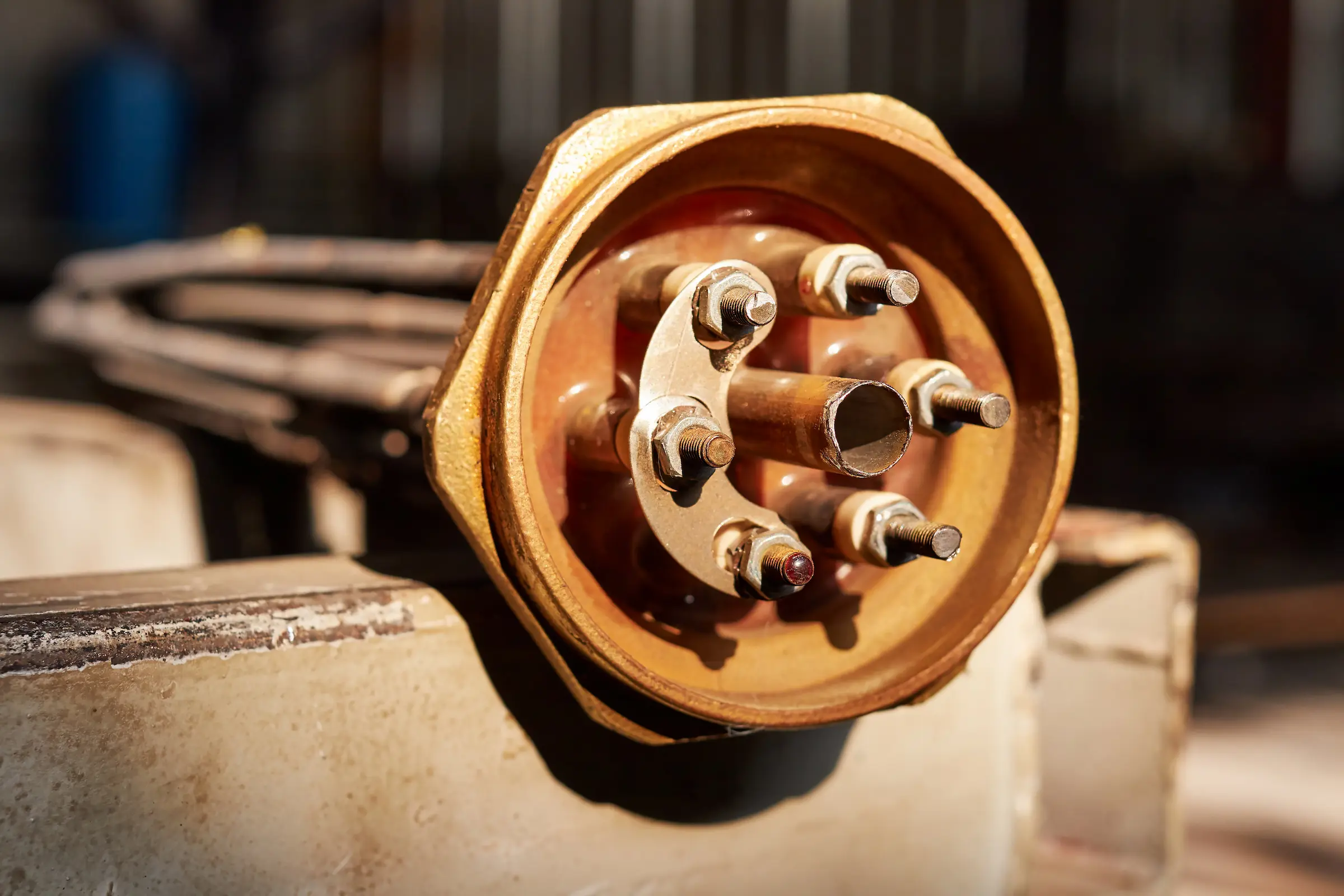
An electric tank has two heating elements, an upper and a lower, and each one has its own thermostat. The upper element heats the top of the tank first, then hands off to the lower one. If the upper element or its thermostat fails, there’s no hot water at all. A dead lower element tends to show up as lukewarm water that never gets fully hot. Ian shuts off the breaker and tests each element and thermostat with a meter, so only the failed part gets replaced.
Above the upper thermostat sits a red reset button. It’s part of a high-limit switch that cuts the power when the water gets too hot. If the reset button keeps tripping, something is overheating the tank, and pressing it again won’t change that. A thermostat stuck in the on position or a shorted element is the usual cause.
A replacement element goes in with the water drained below its opening. Power stays off until the tank has filled again, since an element switched on while it’s dry fails almost at once.
Lukewarm Water, Dip Tubes and a Rumbling Tank
Cold water enters a tank through the dip tube, a plastic pipe that reaches down toward the bottom. A tube that’s cracked or broken short lets incoming cold water out near the top, right where hot water leaves for the house. Small white plastic flakes caught in a faucet aerator are often what’s left of a dip tube. Replacing one is a part job. The cold line comes off the top of the tank, the old tube comes out and a new one drops in.
A rumbling tank means sediment on the tank floor, with steam bubbles forcing their way up through it. Ian clears that out as water heater maintenance, and a repair call is a good time to check whether yours needs it.
Leaks at Valves and Fittings
A puddle by the heater often traces back to a valve or a connection, and those come off with a wrench. The T&P relief valve opens when temperature or pressure inside climbs too high. One that weeps into its discharge pipe may be worn out, or it may be reacting to high pressure, and those call for different fixes. A leaking drain valve near the bottom of the tank is usually a quick part swap. Many homes in Charmeldee Acres near Black Mountain date to the 1950s and 1960s. In a house that age, a drip on top of the heater can be an old galvanized fitting rusting through. These usually turn out to be part repairs:
If none of those is wet and water is seeping from under the jacket or the base, the leak is in the tank itself. At that point the fix is water heater replacement.
Sulfur Smell in Hot Water
When only the hot tap smells like rotten eggs, the cause is usually inside the water heater. Bacteria in the water react with a magnesium anode rod and give off hydrogen sulfide gas. Private wells are a frequent source, and lots in Lynch Cove, just outside Black Mountain, are served by them. Swapping the magnesium anode for a different type and disinfecting the tank usually cuts the smell, though it can come back.
If the cold water smells too, the cause is the supply, not the heater, and Buncombe County Environmental Health offers water testing. A rotten egg smell in the air near a gas heater can be gas, so leave the house first and call the gas utility from outside.
When a Tank Repair Isn’t Worth It
Some tanks are past what parts can fix, and Ian will say so and go over your options as your hot water system supplier. He’s worked in the trade since 2003, and L.34576, his Plumbing Class I Contractor license, is in his own name. Eric Josselyn, a South Asheville homeowner, wrote that he “will be calling them again the next time something breaks” in his review. Ian backs his repair work with a satisfaction guarantee. Call (828) 348-5820 when it quits. Sarah takes calls on that line day or night, and the fuel type and the symptom give Ian a place to start.
Did you know?
Leaky joints are an ancient headache. By 2700 BC, cities in the Indus Valley were laying standardized clay pipes with broad flanges. They sealed the joints with asphalt so they wouldn’t leak.
FAQs About Water Heater Repair in Swannanoa
Some questions tend to come up once the hot water’s back, or while you’re waiting to learn why it quit. Don’t see what you’re looking for? Ask a question here.
It depends mostly on the part that failed, and the fuel narrows which parts are in play. Gas and propane repairs usually involve the thermocouple or gas control valve, electric ones the elements and thermostats. A part low in the tank means draining it first. A heater squeezed into a closet or crawl space is slower to work on, too.
Usually, yes, if you follow the lighting steps printed on the tank’s label. If you smell gas, skip it, get outside and call your gas utility. If the pilot lights but won’t stay lit after a couple of tries, stop and call us, because something has failed.
Wind can push air back down the vent and snuff out a small pilot flame. A loose or missing vent cap, a short vent run or a draft hood that’s out of place makes it more likely. Ian checks the vent from the heater to where it leaves the house. If the pilot goes out on calm days too, the thermocouple or gas control is the next suspect.
Ticking is usually the pipes and fittings on top of the tank expanding and contracting as they heat and cool. It’s harmless, though it can be annoying in a quiet house. Hissing or sizzling on a gas tank means water is dripping onto the burner. That’s often condensation on a cold tank, which fades as it warms, but steady sizzling should be checked for a leak.
Most of the time it’s tiny air bubbles, which are harmless. Fill a clear glass and watch it, and if it clears from the bottom up, it was air. Water that stays cloudy, or carries grit or white flakes, points to something in the tank or the supply. A look at the tank and the aerators usually sorts out which.
Not all the way. The gas or power goes off and the cold supply is closed. Then the pressure is relieved and enough water drains to drop the level below the valve’s opening. A T&P valve on the side of the tank needs more drained than one on top. The new valve goes in with fresh thread sealant, and the discharge pipe is reconnected before the tank refills.
For a short trip, many gas controls have a vacation setting that keeps the pilot lit without heating the tank. On an electric tank, you can switch off the breaker. Leave the cold water supply to the heater open so the tank stays full. When you’re back, set the control or the breaker the way you found it.
It depends on the part and how much of the tank has to be drained. A thermocouple or a T&P relief valve is a quicker swap than a gas control valve or a lower heating element. Then the tank has to heat back up before you’ve got hot water again, and an electric tank takes longer than a gas one. Ian will tell you what to expect once he’s found the fault.
Always ready for tough problems

Do something nice for your pipes
Quick Links
Services
Please Review Us
We sure could use your help letting Swannanoa know how good we are.
Copyright © 2026 O’Sheas Plumbing · Ian O’Shea, Licensed Plumber NC Plumbing Class I Contractor L.34576 · 150 Old Lytle Cove Rd, Swannanoa, NC 28778