

Sewage Ejector Pump Installation
Licensed Sewage Ejector Pump Installation in Swannanoa
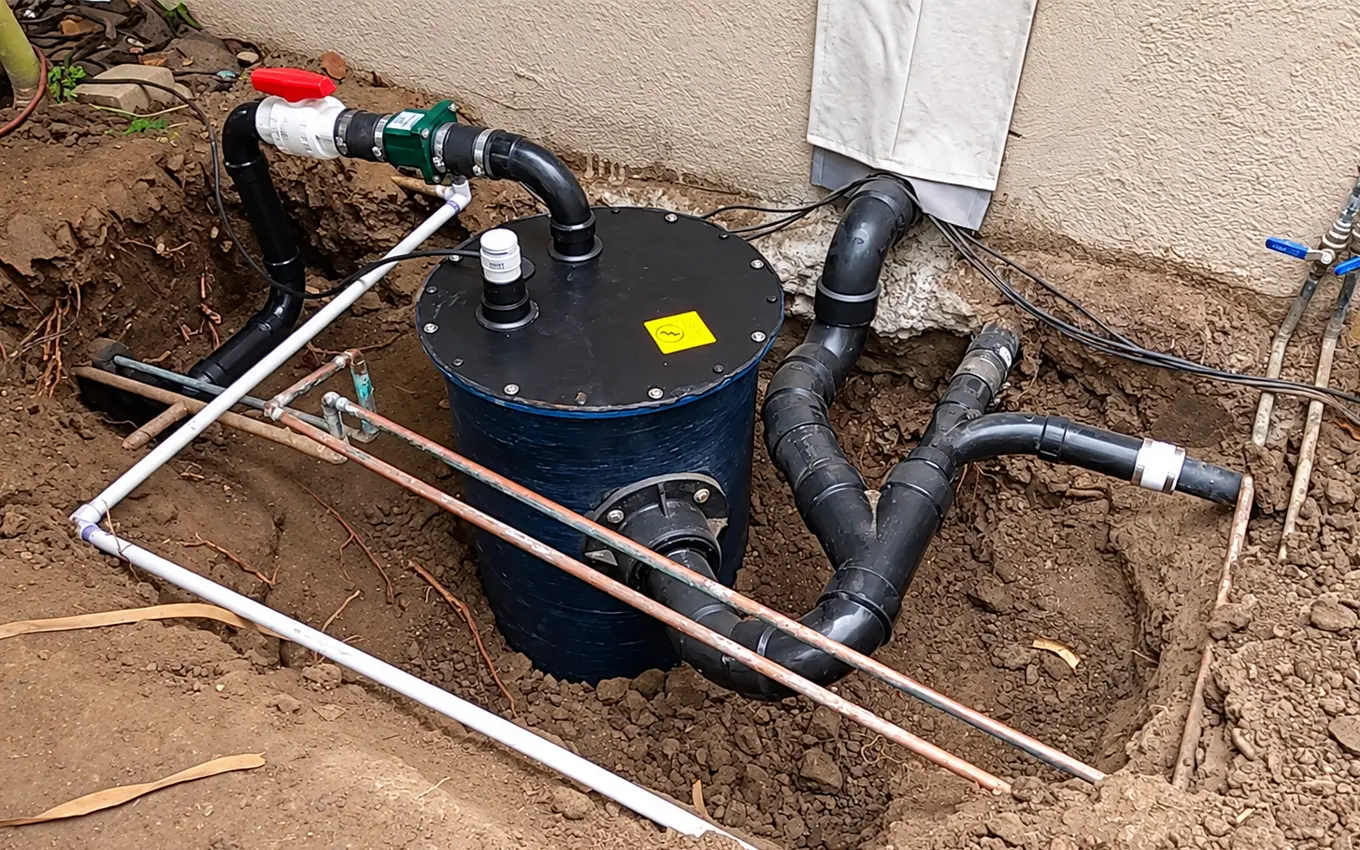
A sealed basin, pump and vent that lift waste from a basement bathroom to the sewer line above it.
A Bathroom Below the Sewer Line
Adding a bathroom, shower or laundry to a basement below the sewer line? A sewage ejector pump installation in Swannanoa makes it work, and Ian O’Shea’s Plumbing Class I Contractor license, L.34576, covers every one we do. The basin, the drains feeding it, the vent and the discharge line all go in as one job, with Ian on site throughout. O’Sheas Plumbing installs sewage ejector pumps for basement bathrooms, laundry rooms and finished lower levels.
Why Homes Below the Sewer Main Need an Ejector
Steep lots bring a lot of elevation change, and some put the street above the lowest floor. A toilet or shower on that floor then sits lower than the pipe it empties into, and its waste can’t climb there on its own. Upstairs fixtures keep draining by gravity, and only the ones below the sewer main go through the pump. On the wooded slopes of Smoky Mountain Estates in Swannanoa, a bathroom on the lowest level can end up lower than its drain. A sewage ejector pump lifts its waste the rest of the way.
Basement Bathroom Additions
A new ejector usually comes with a new room, most often a basement bathroom or a finished lower level with a bath in it. Plenty of homes in Beaucatcher Heights, on the southwestern slope of Beaucatcher Mountain in Asheville, have basement-level living areas. A bath added down there may need an ejector pump to reach the sewer. The basin has to sit lower than every fixture it serves, because each drain still reaches it by gravity. Toilet, shower and sink lines run under the floor and slope down to it. Where the toilet goes in the room often depends on how close it can sit to the basin. Describe the room when you call (828) 348-5820, and we can say where the basin might go.
Basin, Pump and Check Valve Setup
The ejector basin is a tank set down into the floor, with the pump resting at its bottom. A float switch rides up as the basin fills and starts the pump at a set level. The pump pushes the waste up the discharge line until the level drops and the float shuts it off. A check valve on that line closes after every cycle, so what’s been lifted stays lifted. Above the check valve, a gate valve lets the pump come out someday without the discharge line draining back onto the floor. A finished install has each of these in place:
The float heights are set for the basin’s size. Then the pump empties it in full cycles instead of short, frequent bursts.
Venting the Basin and Sealing the Lid
Sewage sitting in a basin gives off sewer gas, and that gas can’t be allowed into the basement. The lid is bolted down over a gasket, and every pipe that passes through it is sealed as well. A vent pipe carries the gas up and out through the roof, either on its own or tied into the house’s other vents. The vent lets air back in, too, so the level can drop smoothly while the pump runs. The sealed lid and the vent work as a pair, and a basin needs both. In a finished lower level, the vent route can set where the basin goes, since that pipe has to climb through the walls above it.
The High Water Alarm and Power at the Basin
A high water alarm has a float of its own, set above the point where the pump turns on. If the level ever climbs that high, the pump has stopped keeping up, and the alarm sounds. Its panel belongs on a wall where people will actually hear it, not in a far corner of a storage room. The pump and the alarm both need power close to the basin. In a basement, the pump often plugs into a GFCI outlet, which cuts power when it senses a ground fault. An alarm only helps if it still has power when the pump doesn’t, so the two shouldn’t hang on one circuit. If there’s no outlet near the basin yet, that gets sorted out before the floor is closed up.
Choosing Pump Size and Head
Two numbers size a pump: how much it moves, in gallons per minute, and how high it can push. The height side is called total dynamic head. It combines the straight vertical lift from the basin with the drag of every foot of pipe. Each fitting along the way adds a little more. On Town Mountain, a ridgetop area of Asheville where basements are especially common, two houses on one road can need very different lift. Basins come in different sizes, and a larger one holds more between cycles, so the pump rests longer. For a lower level that can’t go without a working pump, like a rental apartment, a duplex system with two pumps is an option. The right pump is chosen from the lift your house needs, whatever size the basement happens to be. What sets the size:
Buncombe County requires a permit any time plumbing is added or its design changes, and a new ejector system does both. Ian pulls the permit for a new system himself, before the floor is cut. Cutting a slab and trenching a basement floor is real construction, and O’Sheas Plumbing is insured. The rest of the new bathroom’s plumbing can go to the same plumber who set the basin, under the same license.
If There’s Already a Pump Downstairs
Some lower levels already have a pump, and some of those pumps are decades old. If yours has failed or is wearing out, that’s sewage pump repair and replacement, a separate job from a new install. Adding fixtures to a level that already has a pump needs a second look, too. A second toilet or a new shower sends more water to the same basin. More fixtures on the same basin can mean the old pump is now too small for the job. The pump and basin should be checked against the new load before the new fixtures are tied in. New installs, repairs and grinder pumps all fall under our sewage pump services.
Did you know?
In the mountains, plenty of basements sit lower than the sewer line out front. Gravity can’t carry that wastewater away, so a sewage pump pushes it uphill first, and that’s why pump systems are everyday work around Swannanoa.
FAQs About Sewage Ejector Pump Installation in Swannanoa
Most of what people ask about an ejector comes up while the new room is still bare studs and concrete. Don’t see what you’re looking for? Ask a question here.
Find where the main drain leaves the house. If it goes out through a wall above the basement floor, fixtures on that floor sit below it. Gravity alone won’t carry their waste up to it. If it leaves under the slab, the answer depends on how deep it runs. If you can’t tell, Ian can work it out on a visit.
Yes. One basin can take every fixture on the lower level, as long as each drain can slope down to it. The pump is then sized for all of them. A washer can usually drain to it as well, and its flow gets counted in that sizing.
Usually not. A laundry sink pump is built for gray water from sinks and washers, and it isn’t made to pass solids. A toilet calls for a true sewage ejector in a sealed, vented basin. Often the laundry can be tied into the new basin, so one pump handles both.
A sump pump moves groundwater that collects in a pit and sends it out of the house. An ejector handles what toilets and drains send down, solids included, and lifts it to the sewer. The ejector works inside a sealed, vented basin, while a sump pit is usually open. One can’t stand in for the other.
You’ll probably hear it run for a short stretch each time the basin fills. A thump as it shuts off is often the check valve closing. A quieter style of check valve can soften that, and so can a door between the basin and the living space. If the pump starts sounding louder or running longer than it used to, give us a call.
Mostly how much slab has to be cut, and how far the fixtures sit from the basin. The vent route matters too, especially through finished walls. The discharge line’s lift and length set the pump size. Whether there’s already power near the basin is another factor.
Yes, as long as the valves stay reachable. The check valve and gate valve on the discharge line may need service someday, so they shouldn’t end up sealed behind drywall. An access panel over them keeps the room finished and the valves in reach.
Not much. Press the alarm’s test button now and then to make sure the horn still sounds. If the alarm panel has a backup battery, swap it out on the schedule printed on the panel. Beyond that, the system mostly asks to be left alone.
Always ready for tough problems

Do something nice for your pipes
Quick Links
Services
Please Review Us
We sure could use your help letting Swannanoa know how good we are.
Copyright © 2026 O’Sheas Plumbing · Ian O’Shea, Licensed Plumber NC Plumbing Class I Contractor L.34576 · 150 Old Lytle Cove Rd, Swannanoa, NC 28778