

Tankless Water Heater Installation
Expert Tankless Water Heater Installation in Swannanoa
Gas, propane and electric tankless water heaters installed across Swannanoa by Ian O’Shea.
Service Areas
Tankless Installs Start at the Gas Meter
O’Sheas Plumbing handles tankless water heater installation in Swannanoa, and the gas line gets sized first. A tankless water heater fires a far bigger burner than a tank does, but only while hot water is running. Plenty of gas lines that fed an old tank were never sized for that kind of demand. When the line comes up short, the heater starves right when two showers are running. Ian O’Shea checks the gas line, the venting route, the condensate drain and the wall the unit will hang on. You pick a model after that, with your house’s real limits in front of you.
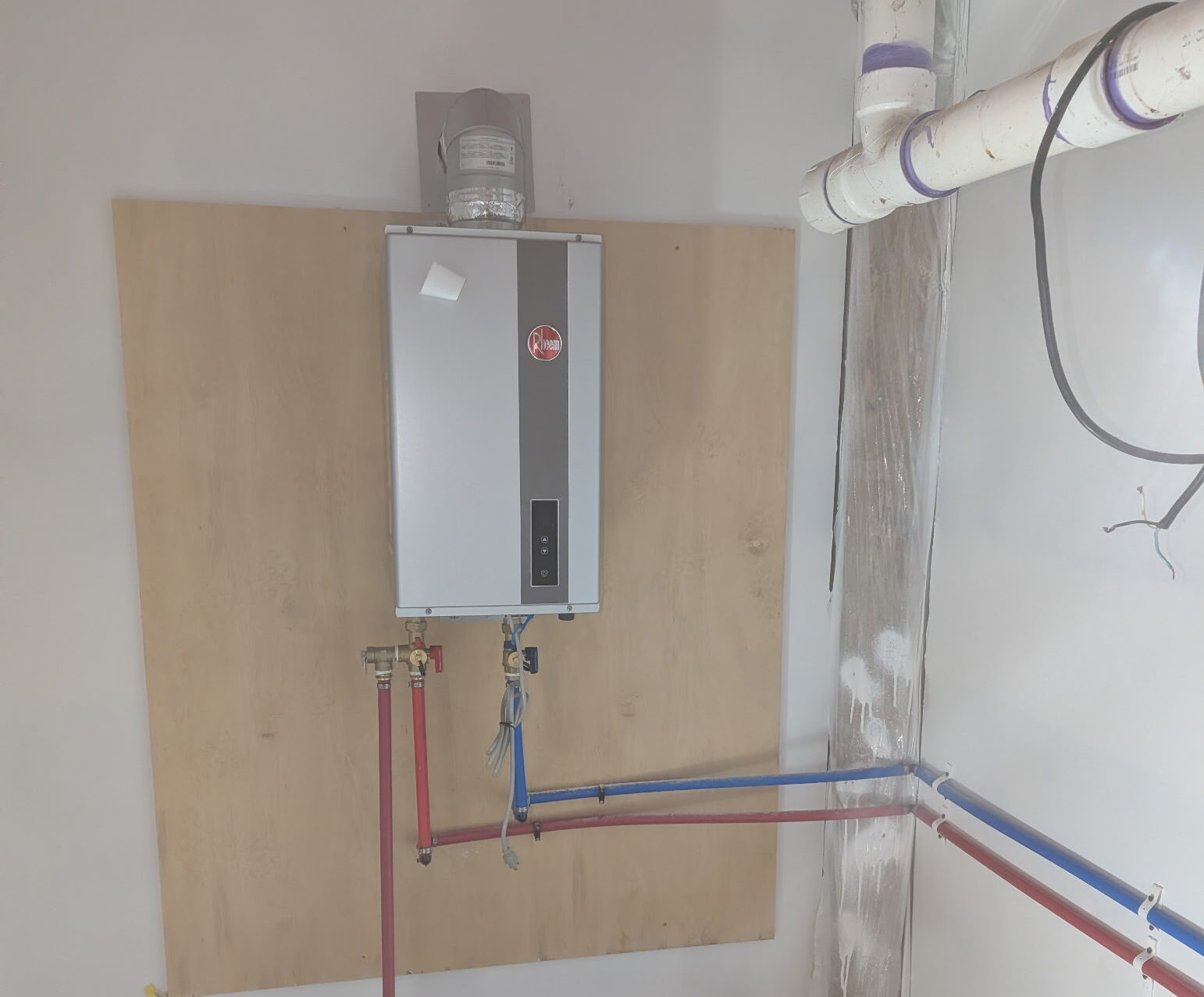
Tank to Tankless Conversion
A tank to tankless conversion changes more than the heater. The old tank comes out, and most of what served it gets rethought. A tankless water heater is a wall mount unit, so the water connections move up the wall and the floor space comes back to you. That counts in a Swannanoa townhome, like some at Cherry Blossom Cove, where the old tank may fill the only utility closet. On a gas unit, the old tank’s flue usually can’t be reused, so plan on new venting. On a typical gas conversion, five things change:
An electric tankless skips the venting and the gas work. It needs a dedicated circuit instead, often more than one, and the electrical panel has to have room for the load. That gets checked before any unit is chosen.
Gas Line Sizing for Tankless Units
For gas line sizing, Ian works from two numbers: the total load on the line and the length of the run. He adds up the BTU input of every gas appliance on the line, with the new heater included. The furnace, range and dryer all count, since they can fire at the same time. Then he measures how far the gas travels to reach the heater. Longer runs lose more pressure, so they need bigger pipe to carry the same load. A line that seems fine with one appliance on can fall short once the tankless unit fires at full input. A propane tankless gets the same math, with the run measured from the propane tank’s regulator.
Venting and Condensate on a Tankless Install
Venting depends on the type of unit. A condensing tankless has a second heat exchanger that pulls extra heat out of its exhaust. That exhaust leaves cool enough to run through PVC venting. A non-condensing unit sends out hotter exhaust and needs the metal vent its manual calls for. Many units can use a concentric vent, one pipe inside another, so intake air and exhaust share one hole through the wall or roof. Every vent run has to stay inside the manual’s limits on length, elbows and clearances, or the unit won’t burn right. Condensing units also make condensate, which is acidic water from the cooled exhaust. It needs a drain, and a condensate neutralizer usually goes in that line first. That’s a small canister of mineral chips that tames the acid before it reaches your pipes.
Sizing by GPM Flow Rate and Water Temperature
A tankless unit is sized by GPM flow rate, the gallons per minute it can heat at one time. That number moves with the temperature of the water coming in. The colder the incoming water, the more degrees the heater has to add, and the fewer gallons it can heat. Well water comes up cool all year. Public water runs coldest in winter, so the same heater delivers less hot water in January than in July. Ian sizes the unit for a winter morning, when the water’s coldest and the house wants the most. He’ll ask which fixtures you run together, such as a shower, the kitchen sink and the washer. You get endless hot water as long as those fixtures stay under the flow rate the unit can heat.
Tankless Units at Mountain Elevations
Swannanoa sits at about 2,225 feet in the Swannanoa River valley, and Black Mountain and the homes up the coves sit higher still. Up here, a gas burner gets thinner air than it would at sea level, so there’s less oxygen for the flame. Many tankless manuals list a high-altitude setting, and a unit left on its sea-level setting can run poorly from day one. That setting gets made at startup on gas and propane tankless units. Electric tankless units don’t burn anything, so elevation doesn’t affect them.
Isolation Valves for Easy Service
Isolation valves go on the cold supply and the hot outlet of the heater, each with a small service port beside it. Close both, and the heat exchanger can be flushed later without cutting into a pipe. Scale slowly builds up inside a heat exchanger, and these valves turn clearing it into a routine visit. Ian does that cleaning as water heater maintenance, and he handles error codes and ignition trouble as tankless water heater repair. At the wall, the finished install includes:
Before you buy a tankless unit, it helps to know what your house can feed it. Ian holds NC Plumbing Class I Contractor license L.34576. The person who sizes your gas line is the same person on site when the heater goes up. For a tank heater, O’Sheas Plumbing is still your hot water system supplier, and for everything else in the house, Ian’s your plumber. We take calls 24/7, so call (828) 348-5820 or send the form, and have a list of the fixtures you run at once.
Did you know?
Home gas water heaters began with a decorative painter. In 1868, Benjamin Waddy Maughan built an instant heater and named it the Geyser, after Iceland’s famous hot spring. It didn’t have a proper flue, so its fumes mixed with the air in the room.
FAQs About Tankless Water Heater Installation in Swannanoa
Most tankless questions come up while you’re still comparing units and nothing’s bought yet. Don’t see what you’re looking for? Ask a question here.
It depends mostly on the gas line and the venting. A gas line that has to be upsized or rerouted is the biggest variable. The vent path, the condensate drain and the mounting spot come next. Electric units shift the work toward the electrical supply, and the fixtures you run at once set the unit size. Call (828) 348-5820 and we’ll talk through your house.
Yes. A propane tankless works off a propane tank, so the tank and its line have to keep up with the heater’s demand. An electric tankless needs no gas at all, but it needs its own circuits and room in the electrical panel. Which one fits depends on what’s already at the house and how much hot water you use at once.
Sometimes. The meter has to pass enough gas for every appliance in the house running together, the new heater included. Ian adds up that load while he sizes the gas line. If the meter can’t keep up, that’s a change for your gas utility, and you’ll know before any work starts.
Usually not. A gas or propane tankless needs electricity for its controls, igniter and fan, so it stops when the power does. A tank water heater with a standing pilot can keep heating through an outage. If your road loses power often, that’s a point in a tank’s favor.
It can, if the unit is rated for that spot. Outdoor models are built for an exterior wall, and their freeze protection needs power to work. A crawl space install needs room to service the unit, a route for the vent and a plan for freezing weather. Ian looks at the space before recommending either one.
The heater starts making hot water right away, but the cold water already sitting in the pipe has to clear first. A bathroom far from the heater waits the longest. A recirculation pump keeps warm water moving through the line so it shows up sooner. It’s easiest to plan in at install, since some units are built to work with one.
It can, because it heats water only when you use it instead of keeping a full tank hot all day. How much you save depends on your household’s hot water use and your fuel. A condensing unit gets more heat out of the same gas. There’s no honest single number, because it rides on your habits.
The owner, Ian O’Shea, is there for every install. He’s been in the trade since 2003. His Plumbing Class I Contractor license covers the gas piping as well as the water side.
Always ready for tough problems

Do something nice for your pipes
Quick Links
Services
Please Review Us
We sure could use your help letting Swannanoa know how good we are.
Copyright © 2026 O’Sheas Plumbing · Ian O’Shea, Licensed Plumber NC Plumbing Class I Contractor L.34576 · 150 Old Lytle Cove Rd, Swannanoa, NC 28778