

Tankless Water Heater Repair
Licensed Tankless Water Heater Repair in Swannanoa
Error codes, failed ignition, cold bursts and freezes on gas and propane tankless units, tested part by part.
When a Tankless Water Heater Quits
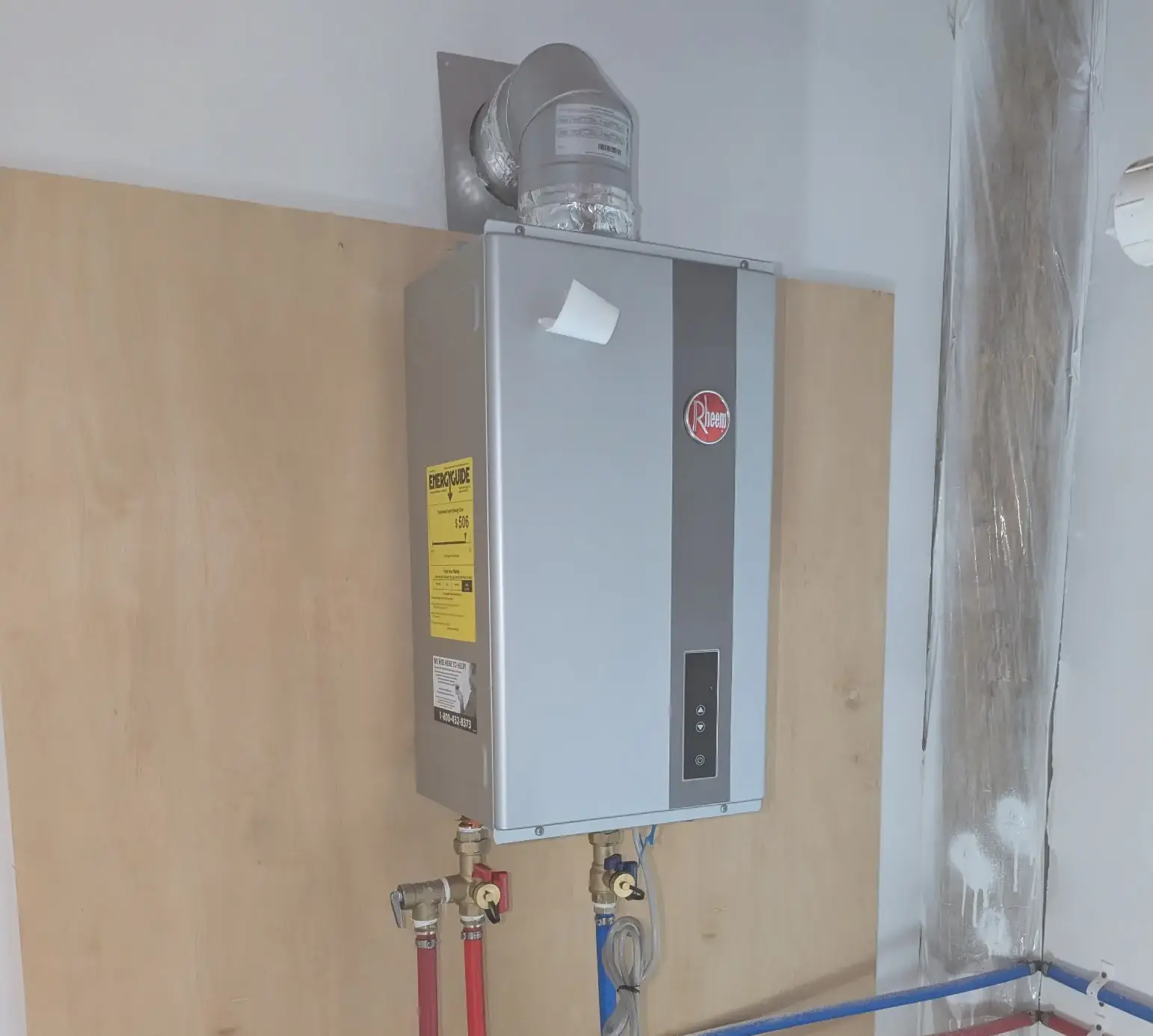
When the shower turns cold halfway through and a code is blinking on the wall unit, it’s time for tankless water heater repair in Swannanoa. A tankless heater does a lot with a few parts. It has to sense water moving, get gas and a spark, prove a flame and push its exhaust outside, all within seconds. If any one of those steps fails, the unit shuts down and stores a code. A blinking code points to where the trouble started, but it rarely names the part to buy. We repair gas and propane tankless water heaters, and Ian tests each of those steps in turn to find the failed one. As your hot water system supplier, we hear about the same few symptoms most often:
Tankless Error Codes and What They Point To
Tankless error codes come from the control board, which watches every sensor while the unit runs. Each maker numbers its codes its own way, so one number can mean flame loss on one heater and a fan fault on another. Ian reads the code against that unit’s manual, then checks the fault history many boards keep. An ignition code sends him to the gas supply, igniter and flame rod, while a flow code points at the inlet screen and flow sensor. Overheat codes often trace back to scale, and venting codes to the exhaust path. The board itself is the last suspect, checked after the sensors around it test good.
Ignition Failure and Flame Rod Faults
An ignition failure means the burner never lit, or it lit and then lost its flame. On each start, the unit opens its gas valve and fires the igniter. The flame rod then has to sense a flame within a few seconds, or the board shuts the gas off. A flame rod coated with oxide or soot can miss a flame that’s burning fine, and cleaning or replacing it often clears the fault. When the flame lights and then drops out, gas pressure is the next thing Ian measures. He reads it at the unit’s test port with nothing firing, then again with the burner at full input. A big drop under load means the heater is starving for gas. The cause might be an undersized gas line, a weak regulator or a propane tank running low. Ian tracks down which one on the repair visit. If the line itself is too small, running a bigger one is a tankless water heater installation job.
Flow Sensor and Inlet Filter Problems
A tankless unit won’t fire until its flow sensor reports enough water moving through it. Every model has a minimum flow rate, and below it the burner stays off. A tap opened just a crack may never reach that rate, and that’s normal. Trouble starts when a wide-open tap can’t reach it either. The first place Ian looks is the inlet water filter, a small screen where cold water enters the unit. Grit and sediment collect there and choke the flow. Some homes in Bee Tree Village draw from private wells. Well water can carry fine sand, and a tankless unit’s inlet screen is where it piles up. On City of Asheville water, work on a nearby main can stir up grit too. If the screen is clean and flow is still weak, the flow sensor may be stuck or failing. Ian closes the isolation valves, pulls the sensor and checks it for debris or a bad reading.
What Causes the Cold Water Sandwich
The cold water sandwich is hot water, then a slug of cold, then hot again. It shows up when one tap shuts off and another opens a minute later. Hot water left in the pipe arrives first. Next comes water that went through the heater while the burner was still relighting. A short cold gap is normal on any tankless unit, but one that’s gotten longer points to a fault. A burner that’s slow to light points back to the ignition checks above, and a sluggish flow sensor does the same. In a house with a recirculation loop, a failed check valve can let cold water cross into the hot line. A small buffer tank or a working recirculation pump can shorten the cold gap, and Ian can check whether either suits your house.
Venting Faults, Condensate and Freeze Damage
A tankless unit’s fan pushes exhaust out through its vent, and the board stops the burner when that path is blocked. A venting fault code can mean an exhaust blockage at the outside terminal, a vent joint that’s pulled apart or a fan that’s wearing out. On wooded lots, leaves and nests can end up in sidewall vent terminals. Condensing units add a condensate trap, and a trap clogged with debris backs water into the unit until it shuts down. Freeze damage goes deeper than a blocked vent. Christmount, just outside Black Mountain, lists snow removal among its community services, and cold like that can freeze a unit mounted outside. Water that freezes inside a unit in a cold crawl space can crack the heat exchanger or split a valve. After a venting code or a hard freeze, Ian checks:
A heat exchanger split by ice usually means a new unit, and you’ll hear that up front. Smaller freeze damage, like a cracked valve or sensor housing, is often a straight repair.
When to Book Maintenance Instead
Heat exchanger scale is the mineral crust left behind as water is heated. As it builds, the exchanger runs hotter, flow drops and the unit may throw an overheat code or start to make a kettling sound. Once scale has shut the heater down, Ian clears the overheat fault first and then descales it as water heater maintenance. A unit that’s already throwing codes needs the repair first, and the routine can come after. If the unit runs fine and no code is showing, maintenance is the right call. Keeping scale from building up in the first place is a visit you book on a schedule, while the unit still runs well.
Before You Call About a Tankless Repair
Write down the code on the display before you call. Note when the trouble shows up, whether it’s every time, only with two taps open or only on cold mornings. Tell us if the power or gas was off lately, or if anything new was added to the gas line. Ian’s license is Plumbing Class I Contractor, L.34576. Ian is there for the testing, the repair and the final check. Calls to (828) 348-5820 are answered 24/7, so call with the code in hand.
Did you know?
Plumbers are named after lead. The word comes from plumbum, Latin for lead, because the first good pipes in Roman times were made of it. It’s the same reason lead’s chemical symbol is Pb, short for plumbum.
FAQs About Tankless Water Heater Repair in Swannanoa
A blinking code, a cold shower or a puddle under the unit usually raises one of these. Don’t see what you’re looking for? Ask a question here.
Usually, if the heat exchanger is sound. Sensors, igniters, flame rods, fans and boards can all be replaced while the rest of the unit keeps working. A cracked or leaking heat exchanger is the main exception, and parts for some older models get hard to find. Ian will tell you which side of that line your unit is on.
Yes, once. Turning the power off and back on clears many codes, and if the unit runs normally afterward, keep an eye on it. If the same code returns, stop resetting and call us, because the part behind it still needs testing. If you smell gas, skip the reset, get everyone out and phone your gas utility from outdoors.
It stops firing when something it watches falls out of range. A flame that won’t hold, flow below the unit’s minimum, overheating from scale or a blocked vent can each do it. A low-flow showerhead can sit right at the edge of that minimum, especially with a partly clogged inlet screen. The code on the display narrows it down.
Start by finding where the water comes from. A drip from the relief valve, a loose fitting under the unit or an overflowing condensate line can all be repaired. Water from inside the cabinet is more serious, since it can mean a cracked heat exchanger. Turn the unit off, close the isolation valve on its cold side and call (828) 348-5820.
Don’t run hot water through it until it’s checked. Turn the unit off, close the water valves to it if you can and look for water around the cabinet. Ice can crack the heat exchanger or split a valve body, and the leak may not show until it thaws. Ian tests the unit under water pressure before it goes back in service.
The part that failed sets most of it, along with how much room there is around the unit. A dirty flame rod or a clogged inlet screen is a small job, while a control board or flow sensor takes more in parts. A cracked heat exchanger can tip the decision toward a new unit. Low gas pressure or a blocked vent upstream means work beyond the part itself.
Yes. The control board is electronic, and a surge from a nearby lightning strike or a storm can damage it. A unit with a blank display or a board code after a storm needs its power supply and board tested. Surge protection for the whole house is work for an electrician, and the heater’s board and controls are ours to test.
Something on the gas side changed, often a new range, dryer or generator on the same line. When everything runs at once, the heater gets what’s left.
Always ready for tough problems

Do something nice for your pipes
Quick Links
Services
Please Review Us
We sure could use your help letting Swannanoa know how good we are.
Copyright © 2026 O’Sheas Plumbing · Ian O’Shea, Licensed Plumber NC Plumbing Class I Contractor L.34576 · 150 Old Lytle Cove Rd, Swannanoa, NC 28778